
Client
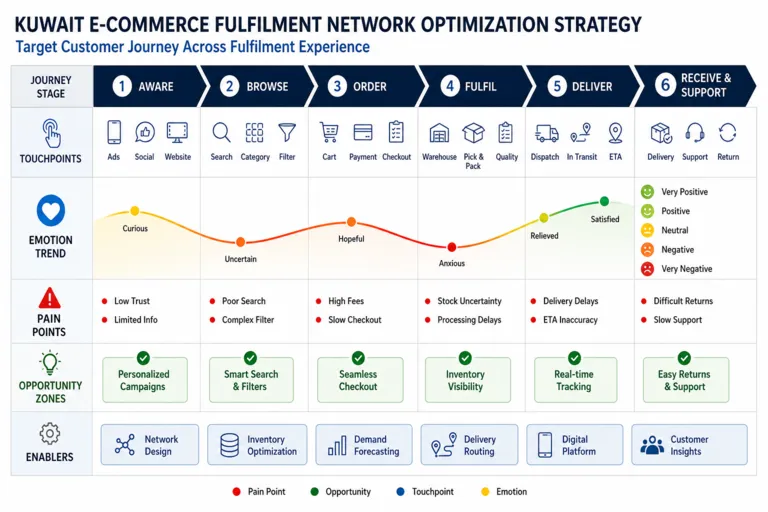
A fast-growing e-commerce and fulfilment operator engaged us to assess how its warehouse and last-mile network should evolve in Kuwait. The company was experiencing increasing order volumes but needed to determine whether additional warehouse capacity, a second fulfilment location, or better network design would provide the strongest operating model.
Issues
The existing operation had developed incrementally, creating uneven warehouse utilization and inefficient delivery patterns.
Management lacked visibility on whether current capacity constraints were caused by insufficient space, inventory allocation, picking processes, or last-mile routing.
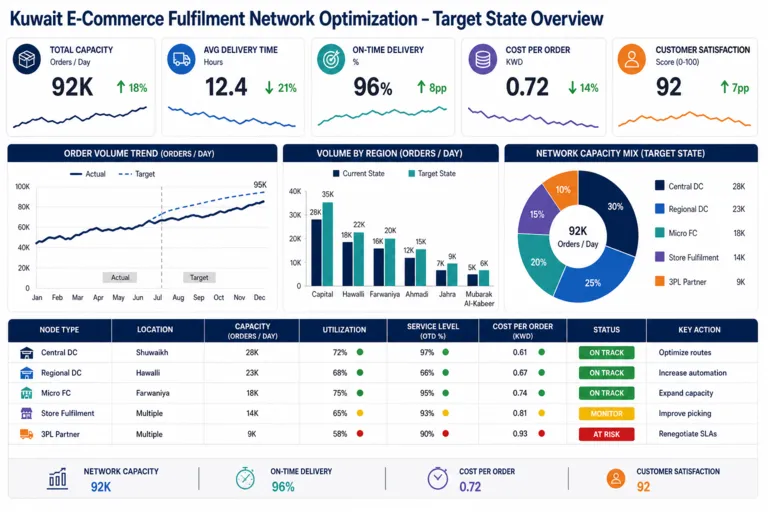
Customer demand also varied substantially across Kuwait City, Hawally, Farwaniya, Jahra, and Ahmadi.
Solution
We developed an integrated fulfilment and distribution strategy covering order demand, inventory flows, warehouse capacity, customer geography, delivery economics, and future volume scenarios.
Approach
Orders were mapped by customer location, product category, frequency, delivery window, and average order size.
We then modelled several network alternatives, including additional warehouse capacity, a second fulfilment node, and centralized inventory supported by improved zone-based delivery planning.
Recommendations
We recommended retaining a centralized fulfilment model in the near term while redesigning inventory allocation and delivery zones.
Additional warehouse capacity would only be activated once predefined throughput and utilization thresholds were reached.
Engagement ROI
The analysis gave management a clear basis for deferring the second fulfilment site and prioritizing operational improvements within the existing network. The recommended model was projected to improve warehouse utilization from approximately 71% to 77%, reduce delivery kilometres per order by around 6%, and potentially defer major capacity expansion by six to nine months, depending on order-volume growth.